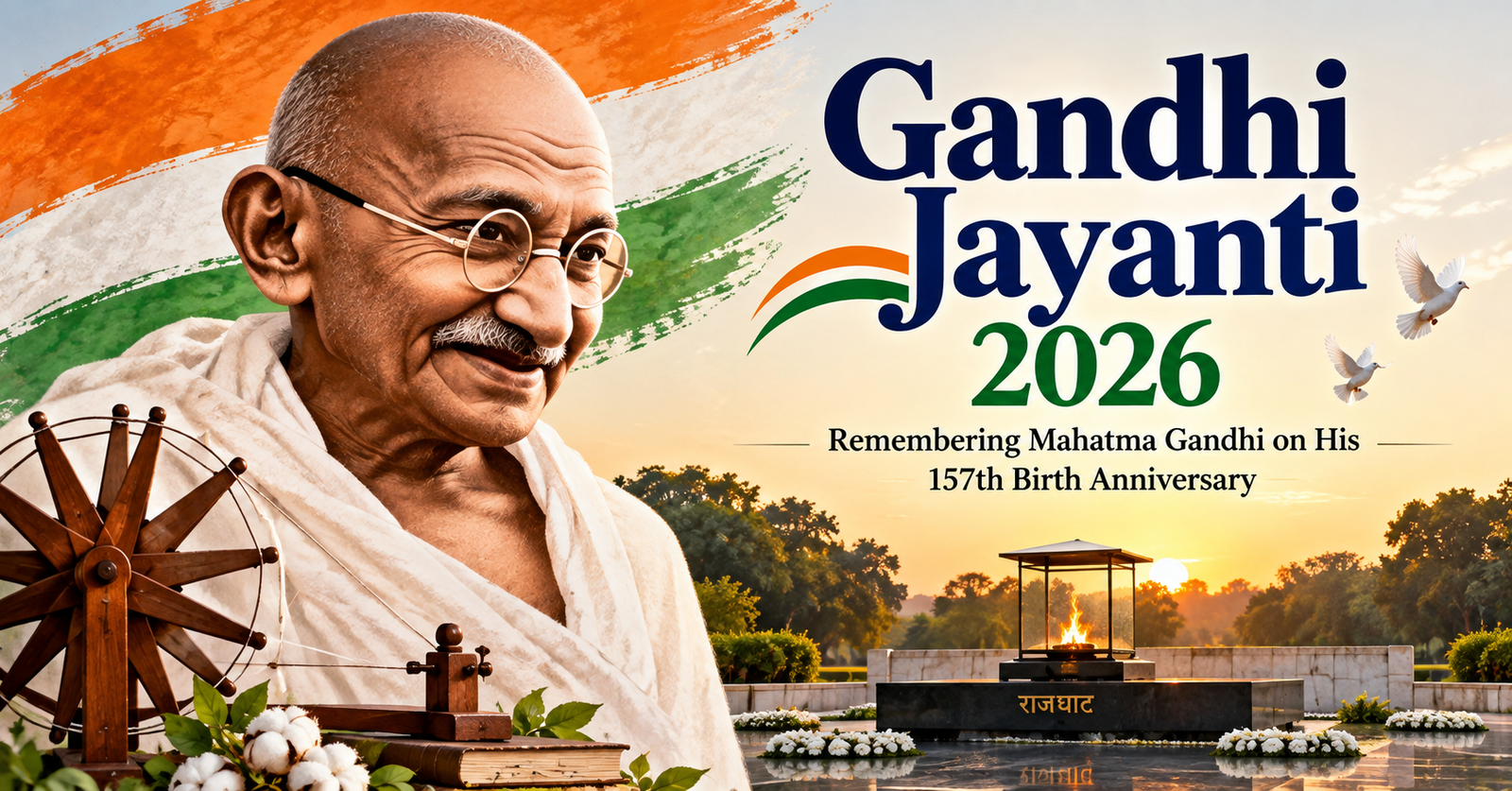
Gandhi Jayanti is being observed across India today, October 2, 2026, marking the 157th birth anniversary of Mahatma Gandhi. The day is remembered not only for Gandhi’s role in India’s freedom movement but also for the ideas of truth, non-violence and Satyagraha that became closely associated with his public life.
Born on October 2, 1869, in Porbandar, Gujarat, Mohandas Karamchand Gandhi went on to become one of the most influential figures of India’s freedom struggle. The Government of India continues to observe his birth anniversary as Gandhi Jayanti, while the United Nations marks October 2 as the International Day of Non-Violence.
Gandhi Jayanti 2026 Date and Birth Anniversary
Gandhi Jayanti is celebrated every year on October 2. In 2026, the occasion marks Mahatma Gandhi’s 157th birth anniversary.
The date is included in India’s official holiday calendar as Mahatma Gandhi’s Birthday. Across the country, government institutions, schools and other organisations hold programmes and ceremonies to remember Gandhi and his contribution to the national movement.
Who Was Mahatma Gandhi?
Mahatma Gandhi was born as Mohandas Karamchand Gandhi in Porbandar on October 2, 1869. He studied law in London before returning to India and later spent several years in South Africa, where his experiences with racial discrimination shaped his approach to civil rights and peaceful resistance.
Gandhi returned to India in 1915 and became a prominent figure in the freedom movement. His methods relied heavily on Satyagraha, a form of non-violent resistance based on truth and moral conviction.
His political and social work became closely connected with several major movements against British rule.
Gandhi’s Role in India’s Freedom Movement
Gandhi played a central role in several major phases of India’s independence movement. The Champaran Satyagraha of 1917, the Non-Cooperation Movement, the Salt March and the Quit India Movement are among the important chapters associated with his leadership.
The Salt March of 1930 became one of the most recognisable examples of Gandhi’s approach to civil resistance. Gandhi and his followers challenged the British salt law through a long march to the coastal village of Dandi.
His emphasis on non-violent action made Satyagraha an important part of the freedom struggle and later influenced civil rights movements beyond India.
Why Is Gandhi Jayanti Celebrated?
Gandhi Jayanti is an occasion to remember Mahatma Gandhi’s life and the principles associated with him, particularly truth and non-violence.
The observance also has an international dimension. The United Nations declared October 2 the International Day of Non-Violence in 2007, giving the date a global connection with peace and non-violent action.
In India, Gandhi Jayanti is also associated with cleanliness campaigns, community programmes, educational activities and tributes at memorial sites.
Gandhi Jayanti 2026 at Raj Ghat
Raj Ghat in New Delhi remains one of the most important places associated with Gandhi Jayanti observances. The memorial marks the site where Mahatma Gandhi was cremated following his death on January 30, 1948.
Government leaders and dignitaries traditionally pay tribute at Raj Ghat on October 2. Across India, schools, institutions and civic organisations also organise events connected with Gandhi’s life and ideals.
What Did Gandhi Stand For?
Gandhi’s public life was closely associated with several ideas that continue to be discussed today:
- Truth and honesty
- Ahimsa, or non-violence
- Satyagraha
- Self-reliance
- Swadeshi
- Community service
- Simplicity in personal life
These ideas were not limited to the political struggle for independence. Gandhi also wrote and spoke extensively about social reform, village life, education, economic self-reliance and relations between different communities.
Gandhi Jayanti and the International Day of Non-Violence
October 2 has significance beyond India. The United Nations observes the date as the International Day of Non-Violence, recognising Gandhi’s association with peaceful resistance and non-violent action.
This gives Gandhi Jayanti a wider international context. While India observes the day as Gandhi’s birth anniversary, the global observance focuses on promoting a culture of peace and non-violence.
Gandhi Jayanti 2026
Gandhi Jayanti remains one of India’s most widely observed commemorative days. In 2026, the occasion marks 157 years since Mahatma Gandhi was born in Porbandar.
The day brings attention back to a period that shaped modern India while also keeping the discussion around truth, non-violence, social responsibility and peaceful resistance alive.